Decision Fatigue and the Cost of Keeping Every Option Open
By notanswer editorial team · Published May 9, 2026 · Updated May 17, 2026 · 5 min read
There is a particular kind of tired that does not come from doing too much. It comes from holding too much open.
You know the feeling. The job offer you haven't declined but aren't taking. The conversation you should have had six weeks ago. The project that is "still on the table." The apartment you looked at twice and neither signed nor crossed off. Each one alive, technically. Each one costing you something, quietly, every day you don't resolve it.
This is a version of decision fatigue that doesn't get discussed much. Most conversations about it focus on the cognitive load of making many decisions in sequence. But there is a cost to not making them, too.
Barry Schwartz and the paradox of choice
Psychologist Barry Schwartz made this tension famous in The Paradox of Choice: more options do not always create more freedom. Past a certain point, they can create comparison, regret, and a persistent sense that another path might have been better.
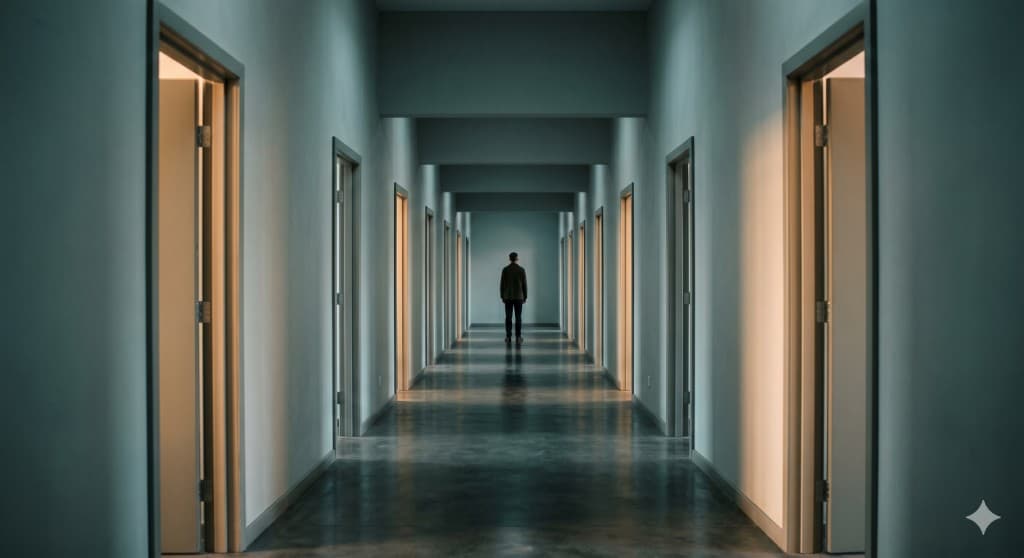
That idea matters here because keeping every option open is not neutral. It extends the paradox instead of resolving it. The choice is between one door and another door, but it is also between deciding and continuing to maintain the emotional inventory of every door you have not closed.
The myth of the open option
When you keep an option open, it feels like you are preserving freedom. You can always go back. Nothing is closed off. The possibility remains.
What this misses is that an open option is not sitting quietly in a drawer. It is running in the background. Some part of your attention is allocated to it — not much, but some — every day it stays unresolved. You are not keeping the option open at no cost. You are paying for it, continuously, in a currency you might not notice until you stop.
Every open option is a small ongoing commitment. You are not keeping your options open. You are paying for each of them, continuously, in attention.
Think about something you have been "still deciding" for longer than it deserves. Notice what your mind does when it arrives near the topic. There is a small expenditure each time. A brief loop. A low-grade version of the bigger deliberation you are putting off. That's the tax.
Why we avoid closing things
Closing an option means acknowledging what you are not choosing. And what you are not choosing often includes a version of yourself — the person who took the other job, moved to the other city, stayed. Closing a door means that version of you is no longer possible, at least not along this road.
That is a small loss, even when the door you're closing was never really right for you. We are bad at accepting small losses, even theoretical ones. So we keep the door technically open and pay the cost of maintaining it.
There is also the fear of regret. If you decline and later wish you hadn't, that is your fault. If you never formally decide, the regret is harder to locate. You didn't choose wrong — you just never chose. This feels like protection. It is mostly expensive.
What the fatigue is actually from
The exhaustion of too many choices is real, but it is less about the number of decisions made and more about the number of unresolved commitments maintained.
A person who makes ten clear decisions in a day, closing each one fully, is often less tired than someone who makes two decisions and keeps eight things unresolved. The eight open items do not rest. They circulate. They pull at attention in quiet moments. This is choice overload in its quietest form — not the paralysis of the menu, but the background hum of every door you left open. It is why you feel vaguely overwhelmed on a day when, technically, nothing much happened.
Closing is not the same as giving up
The thing that makes it hard is that closing feels final in a way that staying open does not. But this is mostly a trick of framing.
Staying open is also a choice. It just feels passive. You are still choosing — you are choosing to keep paying the cost of the open option, choosing to maintain the low-level allocation of attention, choosing to defer the small loss of closing. These are real choices with real costs. They just feel softer than the alternative.
Closing something is not giving up on it in any deep sense. It is acknowledging what is actually true: you are not pursuing this. That is honest. And honesty, it turns out, is lighter than the alternative.
If you have something sitting open that you already know you are not pursuing, closing it starts with a pause — not a plan. Don't force a choice right now. Force a pause instead. One line. Something to hold while the decision settles.
The exhaustion of open options often looks like overthinking, the loop running not because you lack information but because deciding would cost something. And if you find yourself keeping options open about a job, a path, or a relationship, you might already be past information-gathering. Sometimes you already know and are just waiting to admit it.
Related reflections:
- Should I Quit My Job? You May Already Know
- Why Overthinking Isn't a Thinking Problem
- Feeling Lost Is a Location, Not a Verdict
This essay discusses decision-making and the psychology of choice. notanswer.com is an editorial reflection space, not a clinical service.
Unresolved menus drain attention in the background. See if maximizer habits are what keep every door technically open. A quick read, not a command to close everything tonight.
Questions
Decision fatigue is the deterioration in decision quality that comes from making too many choices. But it also describes a subtler problem: the exhaustion of holding too many unresolved options open at once, even when no individual decision is being made.
The standard advice is to reduce the number of decisions you face — automate, simplify, batch similar choices. That helps. But the less obvious approach is closing options you are not actually pursuing. An unresolved possibility is not free. It costs attention even when you are not actively deciding.
Because each open option carries an implicit obligation: to evaluate it, to keep it in view, to feel guilty when you don't. More options often mean more work, not more freedom.
Research by psychologist Barry Schwartz suggests fewer. Beyond a certain point, more options reduce satisfaction rather than increasing it — partly because more alternatives make it easier to imagine you chose wrong, and partly because the work of evaluating them accumulates.
Usually the block isn't about missing information. It's about what closing the door would mean. Ask what you'd have to give up, or admit, if you stopped keeping the option alive. That question tends to find the real hesitation faster than another round of pros and cons.
Closing an option means accepting a small loss: the version of yourself who took the other path. Losses are hard to accept even when they're theoretical. So we keep doors technically open and pay the ongoing cost of maintaining them, rather than accepting the one-time cost of walking away.
FOMO is partly about imagining a different self, one who chose otherwise and is doing better. The antidote isn't suppressing that imagination. It's noticing that staying open also costs something. The question is never really open versus closed. It's which cost you'd rather carry: the ongoing tax of unresolved possibility, or the one-time sting of what you're not choosing.
If your mind is still circling,
sit with one quiet note.